

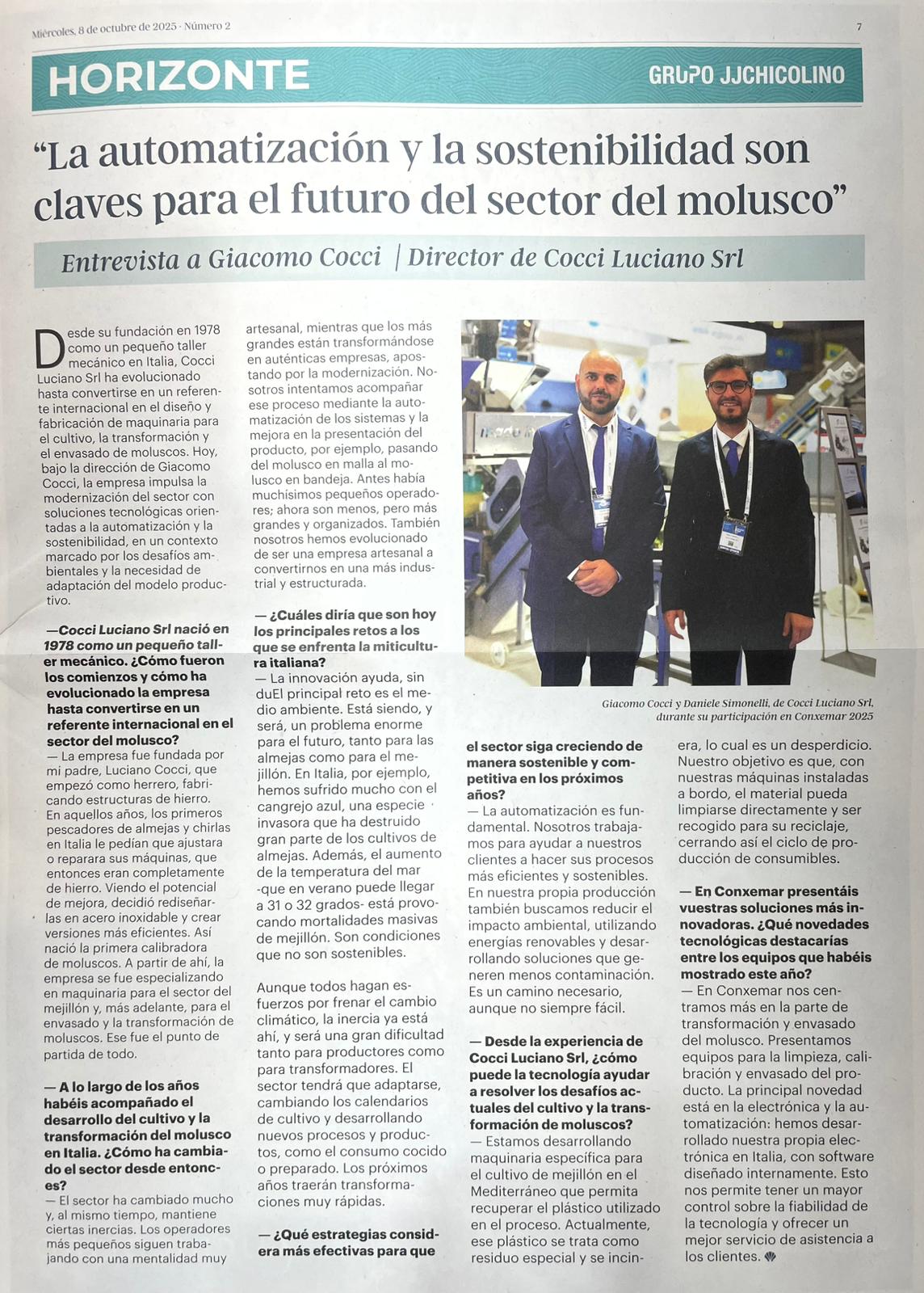
In the monthly magazine Horizonte, the interview with Giacomo Cocci on automation and sustainability
Here the translation:
Founded in 1978 as a small mechanical workshop in Italy, Cocci Luciano Srl has evolved into an international leader in the design and production of machinery for the cultivation, processing, and packaging of shellfish. Today, under the leadership of Giacomo Cocci, the company is driving the modernization of the sector with technological solutions focused on automation and sustainability, in a context marked by environmental challenges and the need to adapt the production model.
- Cocci Luciano Srl was founded in 1978 as a small mechanical workshop. What were the early days like, and how did the company evolve to become an international benchmark in the shellfish sector?
The company was founded by my father, Luciano Cocci, who began as a blacksmith, creating iron structures. In those years, the first Italian clam and carpet-shell clam fishermen would ask him to fix or repair their machinery, which at the time was made entirely of iron. Sensing the potential for improvement, he decided to redesign it in stainless steel and create more efficient versions. This led to the development of the first shellfish sorting machine. From there, the company specialized in machinery for the mussel sector and later for the packaging and processing of shellfish. That was the starting point of everything.
- Over the years, you have accompanied the development of shellfish farming and its transformation in Italy. How has the sector changed since then?
The sector has changed a great deal and yet, at the same time, it still retains a certain inertia. Smaller operators continue to work with a very traditional mindset.
Small producers are becoming more artisanal, while the larger ones are turning into true enterprises, investing in modernization. We try to support this process by automating our systems and improving product presentation—for example, shifting from mesh bags to trays. In the past, there were many small operators; now they are fewer, but larger and more organized. We too have evolved from an artisanal business into a more industrial and structured company.
- What do you think are the main challenges that Italian mussel farming is facing today?
Innovation certainly helps, without a doubt. The main challenge is the environment. It is, and will continue to be, a huge problem for the future, both for clams and mussels. In Italy, for example, we have suffered greatly due to the blue crab, an invasive species that has destroyed large parts of clam farms. Additionally, the rising sea temperatures—which in summer can reach 31 or 32 degrees Celsius—are causing mass die-offs of mussels. These are unsustainable conditions.
Although everyone is working to curb climate change, the momentum is already underway and will represent a significant challenge for both producers and processors. The sector will need to adapt by adjusting cultivation schedules and developing new processes and products, such as cooked or prepared foods. The coming years will bring very rapid transformations.
- What strategies do you consider most effective for the sector to grow competitively and sustainably in the coming years?
Automation is fundamental. We work to help our clients make their processes more efficient and sustainable. In our own production, we also strive to reduce environmental impact by using renewable energy and developing solutions that generate less pollution. It is a necessary path, even if not always easy.
- From Cocci Luciano Srl’s experience, how can technology help address the current challenges in shellfish farming and processing?
We are developing machinery specifically for Mediterranean mussel farming that will allow us to recover the plastic used in the process. Currently, this plastic is treated as hazardous waste and incinerated, which is a waste. Our goal is that, with our machines installed on-site, the material can be cleaned directly and collected for recycling, thus closing the production cycle of consumable materials.
- At Conxemar, you showcased your most innovative solutions. Which technological innovations would you highlight among the equipment presented this year?
At Conxemar, we focus primarily on shellfish processing and packaging. We offer equipment for cleaning, grading, and packaging the product. The main innovation lies in the electronics and automation: we have developed our own electronics in Italy, with internally designed software. This allows us greater control over the reliability of the technology and enables us to provide better support to our clients.